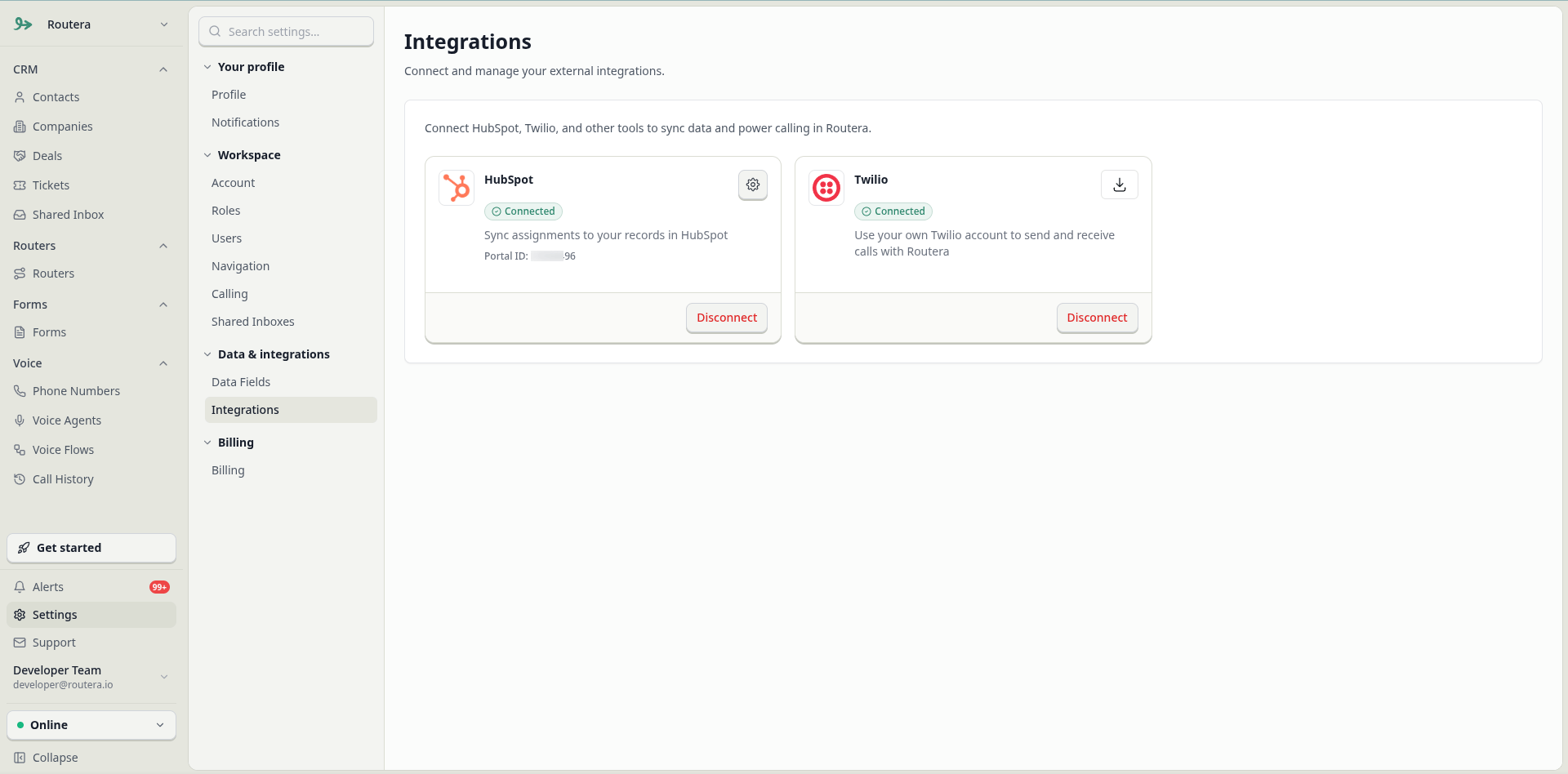
- Go to Settings and open the Integrations tab.
- Under HubSpot, click Connect.
- Select the HubSpot account you want to connect, then click Choose Account.

- Review the permissions requested on the next screen, then click Connect App.
- Once connected successfully, your HubSpot account will appear in the Integrations section of Routera.

You have successfully connected HubSpot with Routera.
Configuring Field Mappings
After connecting your HubSpot account, it’s important to configure field mappings to ensure that data syncs correctly between Routera and HubSpot. Field mappings tell Routera which fields in your Routera object types correspond to which fields in your HubSpot objects.Accessing Field Mappings
- Navigate to Settings > Integrations.
- Find the HubSpot integration card.
- Click the gear icon button in the top-right corner of the HubSpot card.
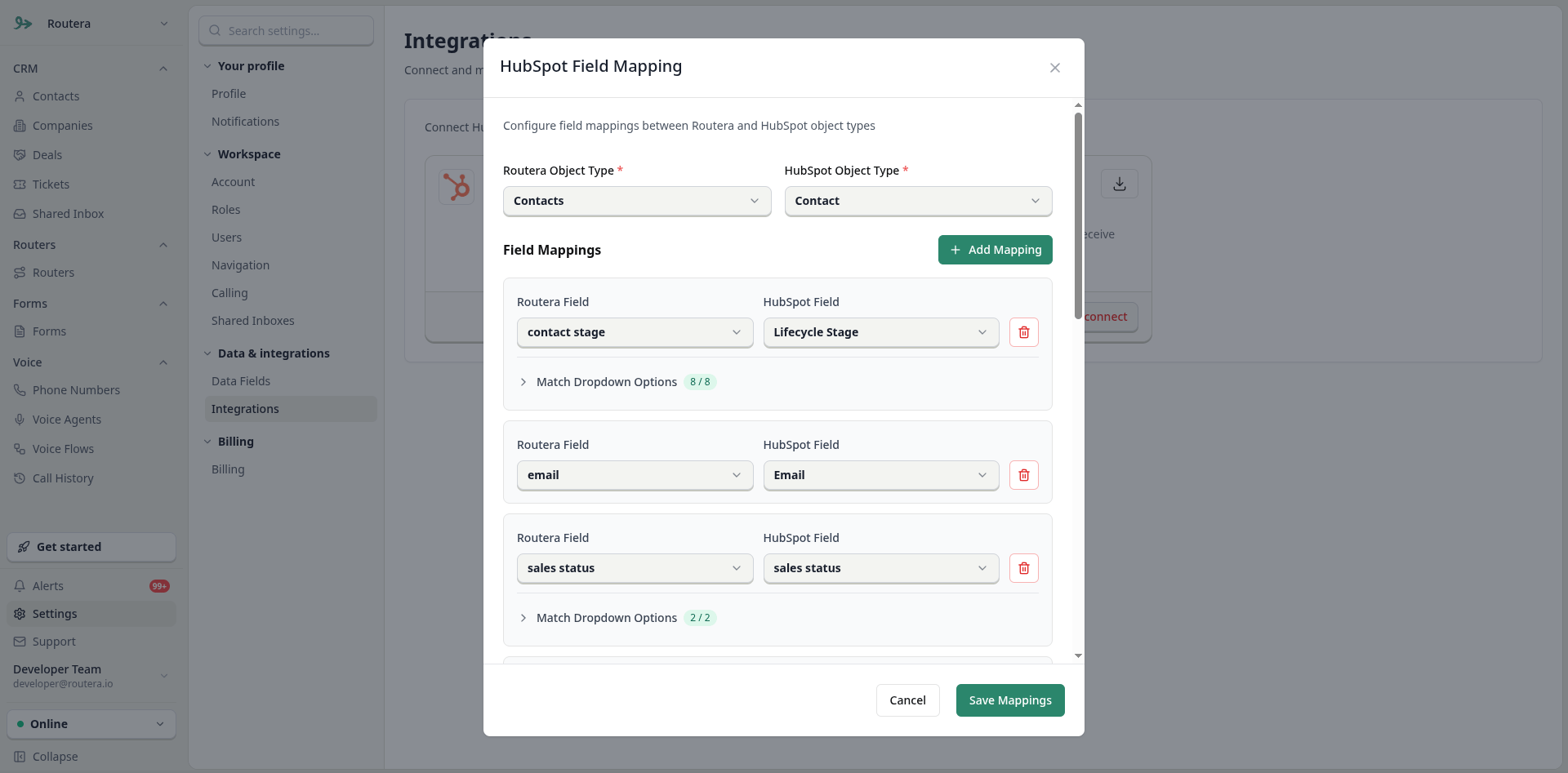
- The HubSpot Field Mapping modal will open.
Creating Field Mappings
Step 1: Select Object Types
-
In the Field Mapping modal, you’ll see two dropdown fields:
- Routera Object Type (required): Select the object type in Routera you want to map
- HubSpot Object Type (required): Select the corresponding object type in HubSpot
- Choose matching object types (e.g., Routera “Deal” with HubSpot “Deal”, or Routera “Contact” with HubSpot “Contact”).
Step 2: Add Field Mappings
- Once both object types are selected, click the Add Mapping button.
-
A new mapping row will appear with two dropdown fields:
- Routera Field: Select a field from your Routera object type
- HubSpot Field: Select the corresponding field from your HubSpot object type
- The HubSpot Field dropdown will automatically filter to show only fields that are compatible with the selected Routera field type.
- String fields can map to HubSpot string fields
- Number fields can map to HubSpot number fields
- Datetime fields can map to HubSpot date or datetime fields
- Enumeration fields can map to HubSpot enumeration fields
- User fields can map to HubSpot enumeration fields
- To add more field mappings, click Add Mapping again and repeat the process.
Step 3: Configure Dropdown Value Mappings (Enumeration Fields)
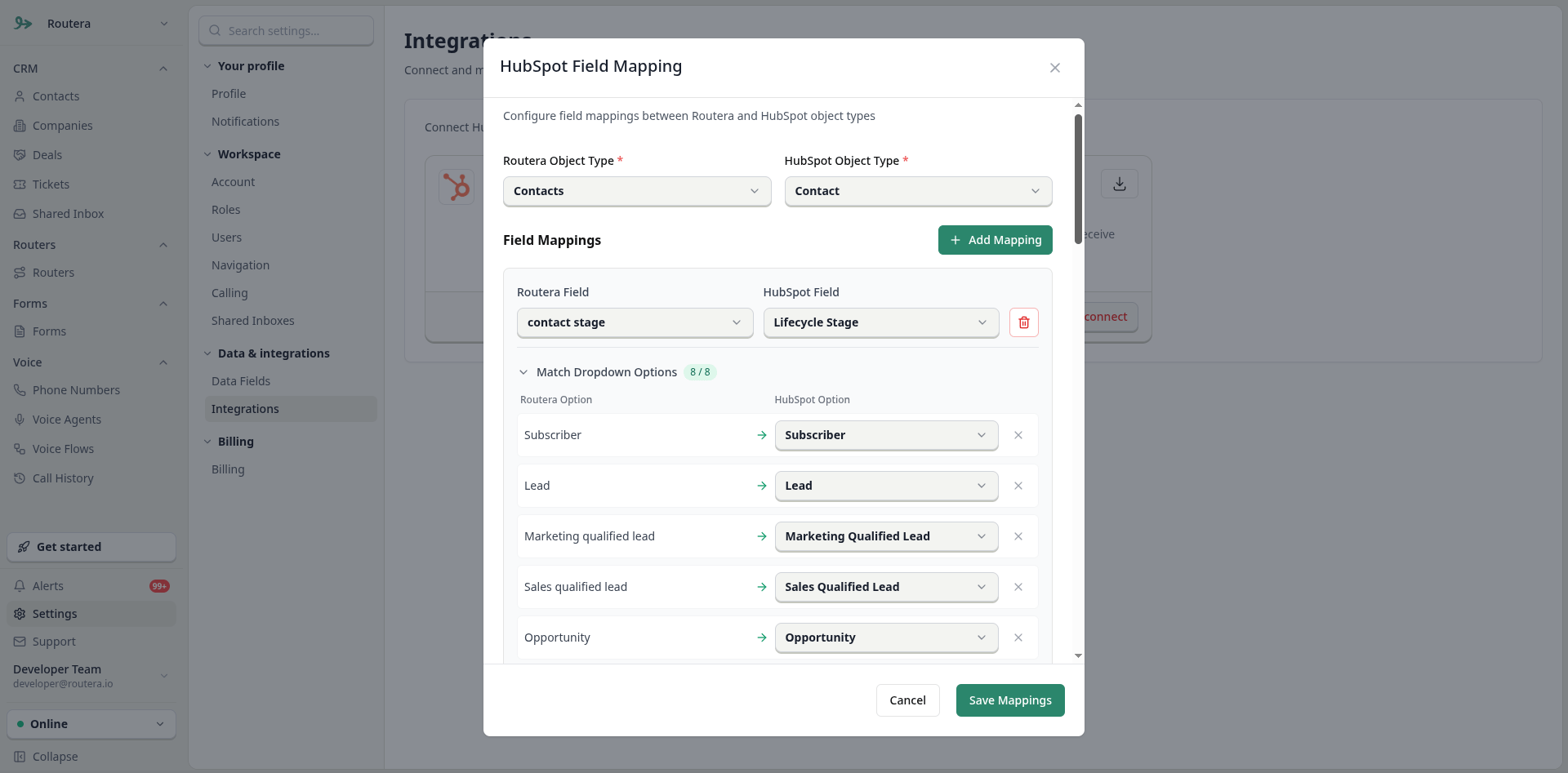
If you’ve mapped an enumeration (dropdown) field, you’ll need to match the individual dropdown options between Routera and HubSpot:- Below the field mapping, you’ll see a Match Dropdown Options section.
- Click to expand this section if it’s collapsed.
- You’ll see a list of all Routera dropdown values on the left and HubSpot dropdown options on the right.
- For each Routera value, select the corresponding HubSpot option from the dropdown.
- A progress indicator shows how many values are mapped (e.g., “3 / 5”).
- Important: All Routera dropdown values must be mapped to a HubSpot option before you can save. Unmapped values will be highlighted in amber/yellow.
- The system will attempt to auto-match values based on name or internal name similarity
- You can clear a mapping by clicking the X button next to a mapped value
- Each HubSpot option can only be mapped to one Routera value
- Unmapped Routera values will be highlighted in amber to indicate they need attention
Step 4: Remove Field Mappings
To remove a field mapping:- Click the trash icon button on the right side of the mapping row
- The mapping will be removed from the list
Step 5: Save Your Mappings
- Review all your field mappings to ensure they’re correct
- Make sure all enumeration field values are mapped (if applicable)
- Click Save Mappings at the bottom of the modal
- You’ll see a success message confirming the mappings have been saved
Your field mappings have been saved successfully.
Editing Existing Field Mappings
To modify existing field mappings:- Open the Field Mapping modal using the gear icon on the HubSpot integration card
- Select the same Routera and HubSpot object types you previously configured
- Your existing mappings will automatically load
- You can:
- Add new field mappings using the Add Mapping button
- Remove field mappings using the trash icon
- Update dropdown value mappings by changing the selected HubSpot options
- Click Save Mappings to save your changes
Best Practices for Field Mappings
- Map All Critical Fields: Ensure all fields that need to sync between systems are mapped
- Complete Dropdown Mappings: Always map all dropdown values to prevent sync errors
- Verify Field Types: Double-check that mapped fields have compatible types
- Test After Mapping: After creating mappings, test the integration to ensure data syncs correctly
- Document Custom Mappings: Keep notes on any non-obvious field mappings for your team
Troubleshooting Field Mappings
Issue: Can’t see HubSpot fields after selecting object type- Ensure your HubSpot integration is properly connected
- Check that you have the necessary permissions in HubSpot
- Try refreshing the page and opening the modal again
- Make sure all Routera dropdown values have a corresponding HubSpot option selected
- Check that no HubSpot option is mapped to multiple Routera values
- Verify that the HubSpot field actually has the options you’re trying to map
- Verify the field types in both systems match the compatibility rules
- Some HubSpot custom fields may have different types than expected
- Contact support if you believe fields should be compatible but aren’t showing as such
- Ensure you clicked “Save Mappings” and saw a success message
- Check that both object types were selected before saving
- Try refreshing the page and reopening the modal to verify mappings were saved
Why Field Mappings Matter
Field mappings are essential for:- Data Synchronization: Ensuring records sync correctly between Routera and HubSpot
- Capacity Tracking: If you’re using the Capacities feature, enumeration fields must be mapped for capacity tracking to work properly
- Data Integrity: Preventing data loss or corruption during sync operations
- Workflow Automation: Enabling automated workflows that depend on field values